Also October 12
I had to make this a separate post because I was too tired to add anything else to my earlier blog and there were so many interesting things to mention about both towns.
First Capranica. I like the name. It’s fun to say. Ok then. Along the Via Francigena, you occasionally have a choice of 1) coming into the town for an espresso and a snack or 2) Ignore it and continue on through the more natural section. Option #1 always wins – of course!
At first glance the town looked like a regular town but as I continued to walk I noticed a big clock tower and an archway. That is the way to lure me in!
It turns out that Capranica is another hill town, but my approach and the fact that the incline was so slight in the direction I was walking that it wasn’t until I left the town and went down several long flights of stairs that I realized it was such a hill town. It was a place I would have enjoyed spending more time.
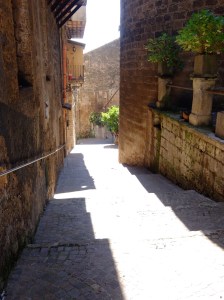
There were the most interesting narrow walkways throughout the entire town. Every time I turned my head there was a walkway leading down.
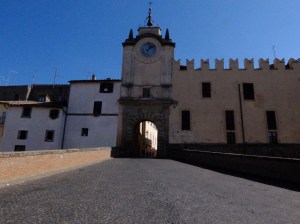
The clock tower
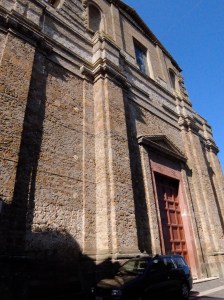
Church

Gigantic tall door of the church
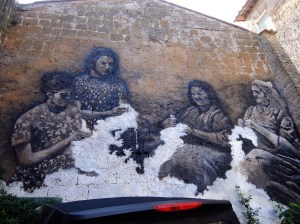
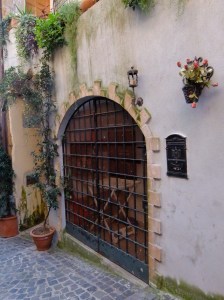
Interesting door
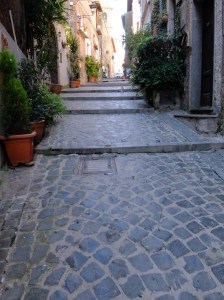
Everyone has plants and flowers
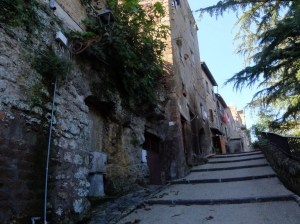
Heading out of the town
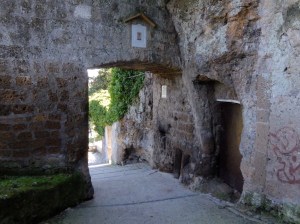
More twists and turns going down
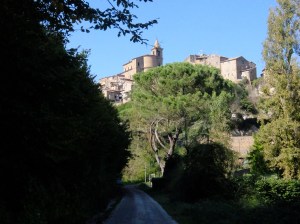
Looking back we see the hill town!
I walked alone yesterday. Suzanne was taking the bus and intended to get off in Capranica but missed the stop and continued on to Sutri. She was so sad and so was I. I was looking forward to walking together. Tomorrow…
Sutri
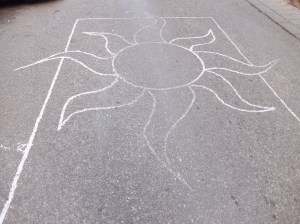
Such an interesting and old city. There is an amphitheater and Etruscan ruins just outside the city walls. There was also street art throughout the town, huge arches not only at the city wall entrances but also in a few other streets.
From Wikipedia:
Sutri (Latin Sutrium) is an Ancient town, modern comune and former bishopric (now a Latin titular see) in the province of Viterbo, about 50 kilometres (31 mi) from Rome and about 30 kilometres (19 mi) south of Viterbo. It is picturesquely situated on a narrow tuff hill, surrounded by ravines, a narrow neck on the west alone connecting it with the surrounding country.
Ancient Sutrium occupied an important position, commanding as it did the road into Etruria, the later Via Cassia: Livy describes it as one of the keys of Etruria, nearby Nepi being the other. It came into the hands of Rome after the fall of Veii, and a Latin colony was founded there; it was lost again in 386 BC, but was recovered and recolonized around 383 BC. It was besieged by the Etruscans in 311–310 BC, but not taken. With Nepi and ten other Latin colonies it refused further help in the Second Punic War in 209 BC. Its importance as a fortress explains, according to Festus, the proverb Sutrium ire, of one who goes on important business, as it occurs in Plautus. It is mentioned in. the war of 41 BC, and received a colony of veterans under the triumviri (Colonia coniuncta lulia Sutrina). Inscriptions show that it was a place of some importance under the empire, and it is mentioned as occupied by the Lombards.
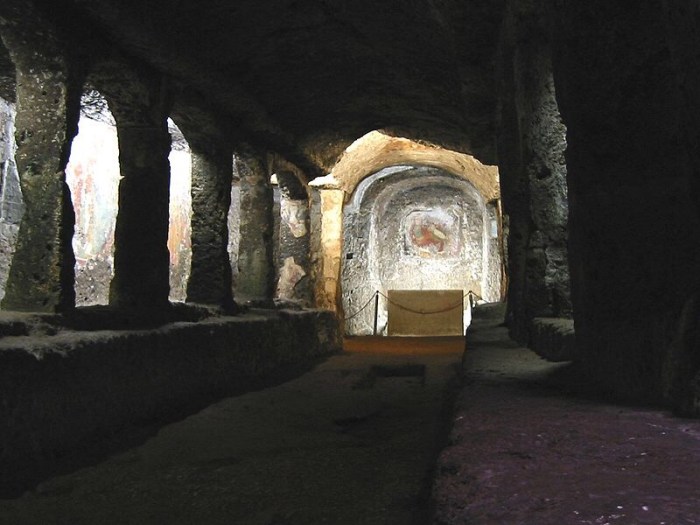
There is more but it’s amazing how old this city is so I had to copy text for you knowledge seekers. The only thing I regret is not making the time to see the cave church below (courtesy of Wikipedia…).
The rest of the photos are mine!

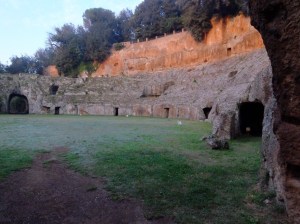
Amphitheater
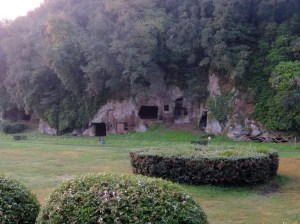
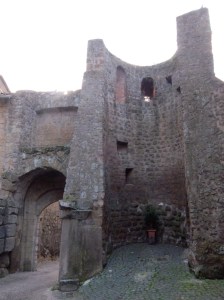
City walls
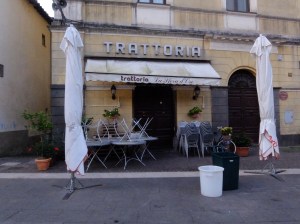

The beautiful piazza where everyone spends evenings
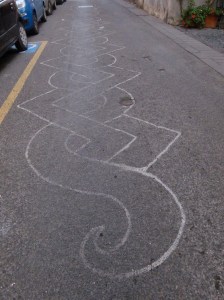
Art work
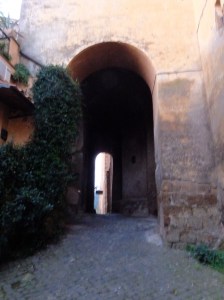
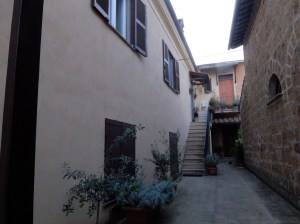
Our lodging for the night Nerones BnB
Two beautiful cities, both hill towns with existing walls.
#enjoythejourney #viafrancigena
 Living Life Every Day