We purchased a 2-day museum pass which means for two days in a row you will be walking through museums. Pick well!
First up was Musee de l’Orangerie to view Monet’s works.
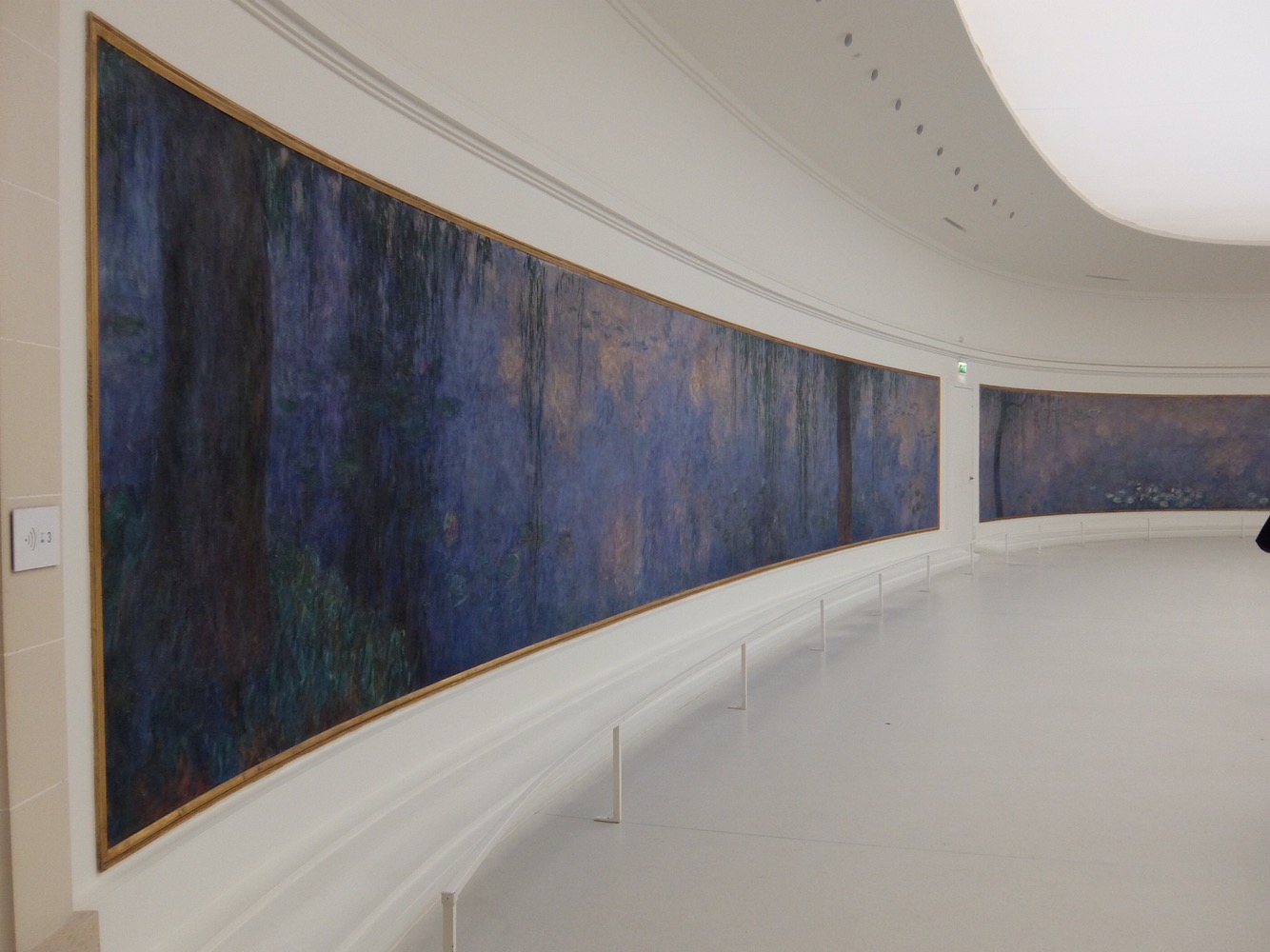

My favorite rooms in Musee de l’Orangerie were Monet’s two rooms that he spent 30 years planning and painting. Here is an excerpt from the Musee website that makes this exhibit even more amazing. http://www.musee-orangerie.fr/en/article/history-water-lilies-cycle
“The Musée de l’Orangerie houses 8 of the great compositions by Monet created from various panels assembled side by side. These compositions are all the same height (1,97m) but differ in length so that they could be hung across the curved walls of two egg-shaped rooms. The artist left nothing to chance with this set of paintings that he had long pondered over and that were displayed according to his wishes in conjunction with the architect Camille Lefèvre and with the help of Clemenceau. He planned out the forms, volumes, positioning, rhythm and the spaces between the various panels, the unguided experience of the visitor through several entrances to the room, the daylight coming in from above that floods the space when the sun is out or which is more discreet when the sun is masked by clouds, thus making the paintings resonate according to the weather…
The whole set is one of the most vast and monumental creations in painting made in the first half of the 20th century and covers a surface area of 200m2. The dimensions and area covered by the painting envelop the viewer in over nearly 100 linear metres, where a landscape of water punctuated with water lilies, willow branches, reflections of trees and clouds unfolds, creating “the illusion of an endless whole, of a wave with no horizon and no shore” as Monet put it. The paintings and their layout echo in the orientation of the building, as the placement of scenes with sunrise hues are to the east and those with hues of the sunset are to the west. Thus, the representation of a continuum in time and space is materialised. In an equally suggestive way, the elliptical shape of the rooms draws out the mathematical symbol for infinity. The Water Lilies paintings at the Musée de l’Orangerie have sometimes had to contend with various events and happenings. In particular, the roof of the second room was damaged during the 1945 bombings as well as one of the compositions, while the other panels remained miraculously unharmed. The 2006 renovation was also the chance to restore the Water Lilies room to its original state, a state that had been lost during the renovation work done in the 1960s that obstructed the natural light Monet had wanted.”
I found that information so interesting and that knowledge makes Monet’s murals even more spectacular! The rest of the museum included works of art from Paul Cezanne, Henri Matisse, Amedeo Modigliani, Pablo Picasso, Pierre-August Renoir among others.
Both Rick and I agree that this museum is the perfect size. We didn’t walk out overwhelmed, with sore feet and a need to sit. It was the perfect museum, and those Water Lillies…
#47daysineurope #paris
 Living Life Every Day